

Are Audiences Sleeping on ‘28 Years Later: The Bone Temple’?
A Conversation With Sami DeMonster & Christian Angeles


Director Nia DaCosta, the brilliant mastermind and director behind such films as the Candyman remake, and of course The Marvels, has really outdone herself; storming into the rage-virus universe of Danny Boyle’s 28 franchise with a sequel that feels bolder, bloodier, and more vicious than before.
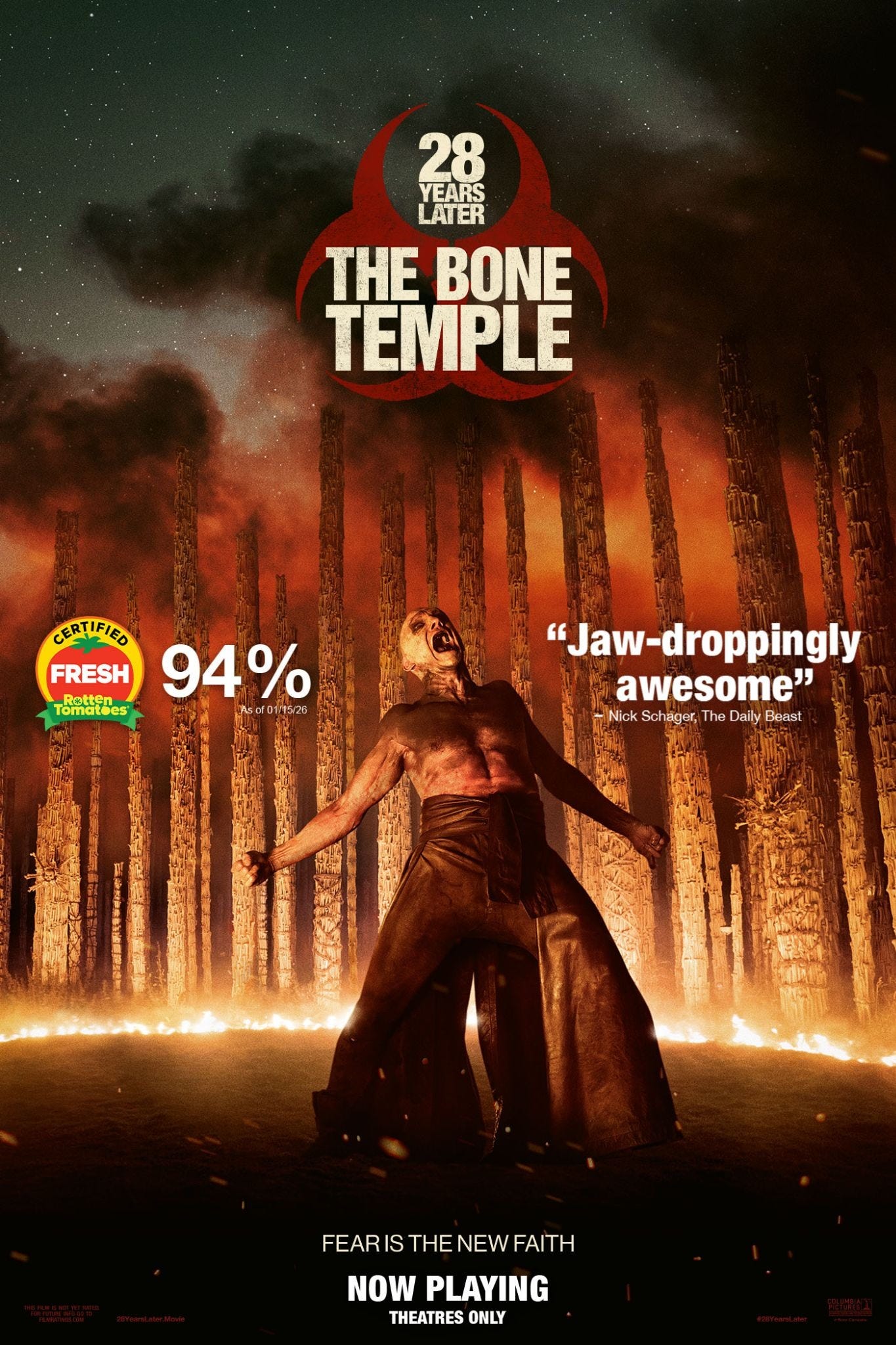
For those unfamiliar, The Bone Temple is part two of the new Danny Boyle and Alex Garland 28 Years Later trilogy. In it, we continue the journey of Spike as he infiltrates the nihilistic world of The Jimmys. New friends are made, traumatic survival moments are had, and Dr. Ian Kelson makes a very naked new friend…
This and more, as we team up to crack open The Bone Temple in this joint review between Sami DeMonster and Christian Angeles. Let’s see if we can answer the question: Are audiences sleeping on 28 Years Later: The Bone Temple?
CHRISTIAN: So this is gonna come as a shocker as one of the world’s biggest Zombiephiles, but I didn’t actually love this movie. Whereas ‘28 Years Later’ was a statement on the geopolitics of isolationism, ‘Bone Temple’ just didn’t land for me with its message about the nature of evil. As the Jimmys were no Negan (the primary antagonist who acts like this in The Walking Dead). They were kinda your kinda run of the mill cult leader and its practices.
But what were your first thoughts, Sami?
SAMI: I am definitely shocked! I personally loved it.
I like that the Jimmys were, as you put it, run of the mill. To me, they were not meant to be the epitome of the evil side of humanity but rather, the dangers of unchecked power and religious psychosis.
Sir Jimmy Crystal was a young kid who snapped when the apocalypse hit and coped by projecting a twisted version of the religious beliefs he grew up with onto the world. He is undoubtedly suffering from religious psychosis. Once a victim of circumstance, he has become a perpetrator of brainwashing and violence. It’s the cycle of trauma.
The people he preyed upon to join his cult were uneducated, impressionable, isolated, young kids in bad situations–the “zombie” apocalypse. Once they joined, their names and identities were erased, robbing them of their individualism and autonomy to give their power to the group–to Sir Jimmy Crystal. I thought the Jimmys were an extreme example of how people become indoctrinated into dangerous groups and beliefs.
The Jimmys were not smarter or stronger than the people that fell victim to their acts of “charity”. The reason this group of mediocre kids in funny wigs got far as they did is because nobody checked them or their leader. They gave Sir Jimmy Crystal too much power when really, he was the weakest one. The Jimmys weren’t special or extraordinary. There are probably dozens of groups similar to the Jimmys roaming around. They aren’t the big bad, they’re the common bad–which is just as dangerous.
I get it, though, I thought they were a little dumb at first!
To you, what worked and what didn’t work in this movie? And how does it compare to Part 1?
CHRISTIAN: What worked? Nia DaCosta. She’s my favorite about this one. What she did with directing this movie is so good in that it’s got a serious style that’s well fleshed out. I love the soundtrack. The set design. The showmanship and cinematography. All the little touches and artistic flair felt different from the first movie.
I think Nia slam-dunked it as director.
I just… surprisingly, I’m not a fan of the script by Alex Garland this time around. Maybe I feel a bit jaded with our current times, and this current administration, but megalomaniac cult leaders who are narcissists that take advantage of their neophyte underlings just… doesn’t super do it for me anymore.
I’ve seen so much of it. We are living through some of the worst of it in American politics. I think I’m just tired of seeing this play out again and again, in fiction, and in real life.
SAMI: That’s absolutely valid, we have seen a lot of this archetype in media and it does hit a little too close to home when we turn on the news and see similar leaders spewing hate from their mouths. It does get old sometimes.
CHRISTIAN: See, I liked part one because it felt unexpected to me. There were twists and turns to their little island society, in that it was an isolated subculture focused around conservatism and tradition—whether they cared to acknowledge it or not—that honestly didn’t work. It was a bravado life rife with bullshit. All best represented in Spike’s dad.
So much of the first movie was the loss of innocence in adolescence. Parents who disappoint you. Mothers who need saving. But it was also a defiance of expectations. Creepy witch doctors who prove to be real doctors. Instead of a spooky bone temple, it was a memorial to the dead. All twists that worked.
This one felt too normal. At least, until the ending. THAT rocked. I loved Alpha and Doctor Kelson’s concert performance.
That’s my kinda weird.
What about you, Sami? What worked or didn’t work for you? And did you have a favorite moment?
SAMI: Nia DiCosta is an incredible director. I agree with everything you said about the aspects you liked about this movie. At first, I also did not love Alex Garland’s script, but the more I sat with it the more I have come to like and respect how weird it is.
Jimmys aside, their part in the movie wasn’t my favorite. I am also team Samson-Kelson as well!
CHRISTIAN: Haha, nice.
SAMI: I loved their story so much. Dr. Ian Kelson is a resilient yet gentle character that brought calm to the world in his own way. The Bone Temple is his way of honoring the dead that the world had forgotten about. He looks and reminds me so much of my dad, so all his scenes had a heavier emotional impact on me.
It also isn’t every day a zombie (Di Costa has said in interviews they are not zombies, they are infected) gets character development. To watch Samson wake up is something so special. Most zombie stories abandon the idea that a cure/solution is possible, they lean into hopelessness. Not only did 28 Years Later: The Bone Temple introduce the beginning stages of a “cure”, they did it in a way I have never seen before. There isn’t a group of scientists developing a serum, there isn’t some chosen one who is immune. Kelson figured out how to treat the mind, he didn’t actually cure the sickness. But maybe this is just the beginning? Samson is somewhere in the middle of a zombie and a human now. He is evolving–he has been even before Kelson!
Watching their friendship blossom as Kelson was getting closer to helping Samson become conscious again was so beautiful. They only had each other. It breaks my heart that Kelson won’t get to know that man that Samson is under the virus!
Change isn’t something most zombie stories explore, so I found the themes of change really refreshing. When we do see change, it’s usually zombies becoming more monstrous, like in The Last of Us and the Resident Evil movies. But these infected people are evolving to be more human! I mean…come on, they had a human baby in part 1!
I can not wait for the conclusion of the trilogy. I can’t wait to learn what is next for Samson and, hopefully, the rest of the infected.
CHRISTIAN: Same!
SAMI: So, to answer your question: Samson and Kelson were my favorite part of the movie–every single scene they were in. What didn’t work? I know I defended the Jimmys but they were the least interesting part of the movie. But they gave us some great Spike and Kelly plots, and I am excited to see where their story goes next!
CHRISTIAN: Kelly, I’m curious about as she’s shown the most growth so far in the movies to me. I also totally relate to Kelson in this zombie apocalypse, but I think we’re supposed to relate to him, as the voice of what’s left of our culture.
SAMI: I love the way you put that. Yes, 100%.
What do you think the 28 Years Later trilogy is doing differently than other Zombie franchises? Are you a fan of 28 Days Later?
CHRISTIAN: I think the trilogy is unique in that it turns so much of what we know about the zombie genre on its own head, which, like the Living Dead movies, is rife with social commentary. The first 28 Years Later being about nationalism, Brexit, and isolationism. This movie being about exploiting our greatest fears and how toxic personalities can charm and exploit. The 28 Years Later franchise is refreshingly addressing the world outside our window. We need this. My only issue is I don’t want to see it end.
Admittedly, I’m also one of the world’s biggest zombiphiles. The Walking Dead, David Cronenberg’s body horrors like Rabid and Shivers, Re-Animator, Dead Alive, Return of The Living Dead, White Zombi, iZombie, Last Man on Earth, and of course, all the George A. Romero movies… I’ve seen it all. Not even mentioning what’s going on in the East with things like One Cut of The Dead or Zom 100.
If that wasn’t enough, I’ve also played every single Resident Evil game, knowing full well RE2 revived the zombie genre, which ya can kinda see in the TV show SPACED, in zombie scenes that would later be the basis of Shaun of the Dead. Simply put. I. Love. Zombies. Well, before it was ‘cool’. It’s a big reason why I’m making a comic about zombies called Dead on the Inside.
So 28 Days Later? Yeah. Huge fan and well-aware of what it did for zombie history. It introduced fast-moving zombies to horror culture with a unique Do-It-Yourself camcorder approach to film that went on to influence so much of cinema and video games.
The Last of Us? Which is my favorite game of all time: inspired by 28 Days Later. The hospital in an empty London setting in the movie? The basis for The Walking Dead’s opening panels in Atlanta.
28 Days Later helped make zombies what they are today. I’m excited to see it connect back to 28 Years Later with the reintroduction of Cillian Murphy.
What about you, Sami? Thoughts about the series connecting back to the beginning?
SAMI: Impressive, Christian! I just learned so much, I had no idea 28 Days Later created the modern fast-moving zombies.
It’s been so long since I’ve seen the original film, I don’t remember much, I have been meaning to rewatch it! I am excited to revisit it before the third film in the 28 Years trilogy. I was about to ask you your thoughts on Cillian Murphy returning. Is it too fan service-y, or the perfect element to connect the new movies to the original movie? I have the opinion of the latter.
CHRISTIAN: Nah, I think it’s great too. And it’s been a very long time since we’ve seen this character. Though now that they’re all together, what do you think this means for Spike and Kelly?
SAMI: I am not sure what it means for Spike and Kelly. He might be the reasonable ally they need. They need some sort of guidance or responsible parental figure to help them figure their sh*t out.
Last question for ya: after Samson’s story in 28 Years Later: The Bone Temple, do you think the series will explore a “cure” on a mass-level? Will we see the “end” of the rage virus? Or the beginning of a group of people somewhere in between a human and a zombie? I wonder how they’d fit into society…
CHRISTIAN: It seems less of a cure and more of a treatment. If we go in the Fido or Day of the Dead direction, I imagine these people would be somewhere in between, stuck in their own zombie society, but humanity will go and screw it up because we suck.
That said, zombie stories never die. I don’t think it ends. Ever. Which is why I’m going 4.5/5 for the franchise. However, I’m 3/5 for this movie. What about you, Sami?
SAMI: Truer words have never been spoken. Zombie stories never die. It is true. I really hope we get that third film. My rating is a 4/5, I’ll need to rewatch it one more time. Might end up a 4.5! Who knows.
So, do I think audiences are sleeping on 28 Year Later: The Bone temple? Yes! I’ve been trying to convince everyone around me to check out 28 Years Later and begin the trilogy! “The Bone Temple” needs more love.
What do you think, Christian?
CHRISTIAN: People should see “Bone Temple” in theaters while they still can. The people behind it are legends at what they do and if you like zombies, you should check it out as the overall stories of this universe are strangely good. Yes people are totally sleeping on it!
SAMI: As of writing this article, news broke that 28 Years Later: The Bone Temple is underperforming at the box office and getting removed from theaters. That breaks my heart, honestly. So this is your reminder to see the film if you haven’t already–which, wow, we spoiled a lot then! And go tell your friends to go see it, now!

Christian Angeles is a writer and entertainment journalist with nearly a decade of experience covering comics, video games, and digital media. He was senior editor at The Beat during its Eisner Award–winning year and also served as managing editor of The Workprint. Outside of journalism, he writes comics and books.
Sami DeMonster is the founder of The DeMonster and a freelance writer for DC.com. She is best known for being a content creator with a focus on comic books, with an emphasis on horror. She works with most major comic book publishers to help promote new titles and encourage people to read more comics!
 | A guest post by
|