

Bullets, Boobs, and Bombshells — Plus Surprisingly Great Noir: An Interview with Charles Ardai on Heat Seeker: Exposed
The founder of Hard Case Crime talks with us about pulp tradition and femme fatales, revealing the craft of hiding surprisingly great stories beneath the cover.

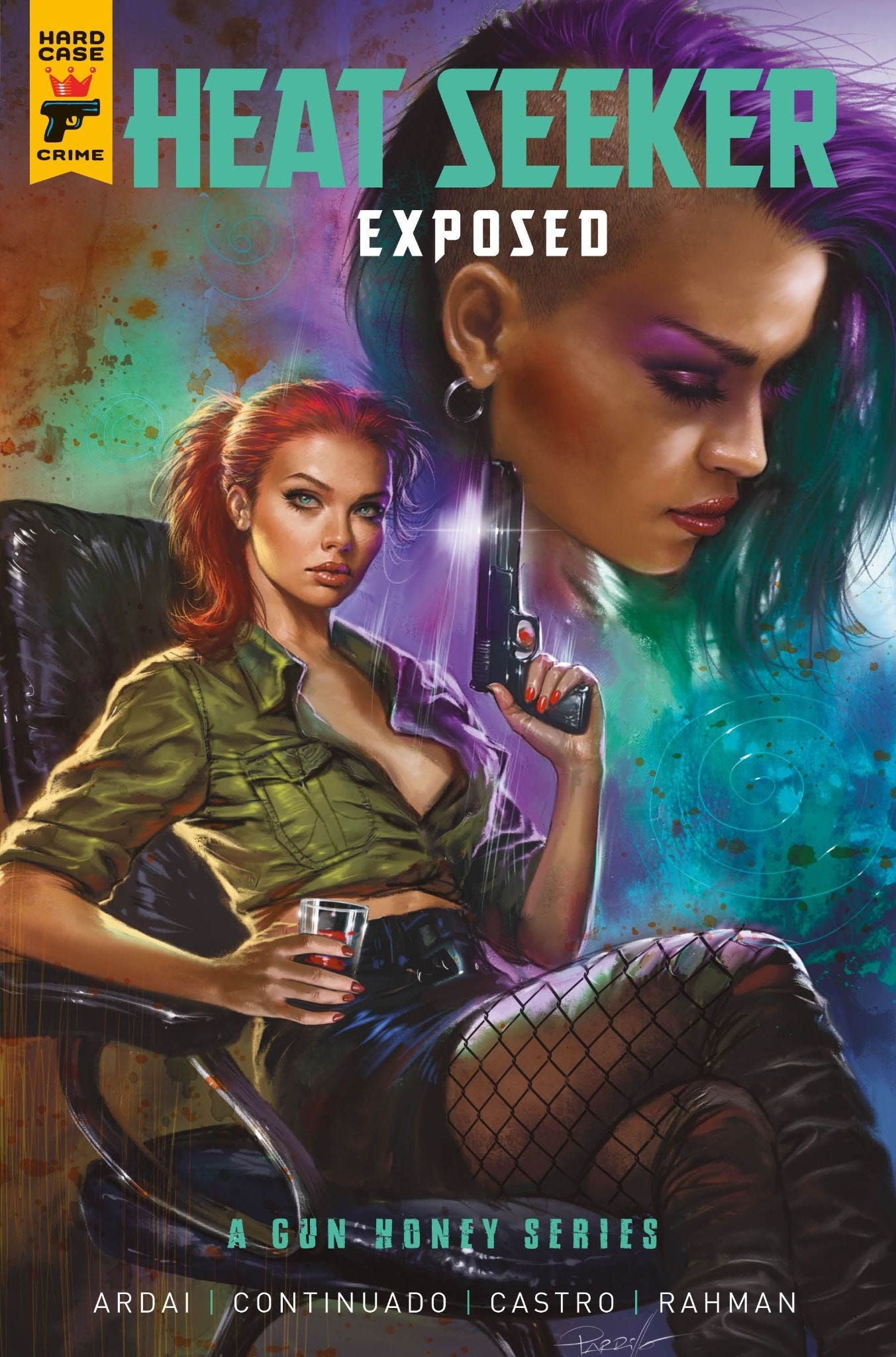
For decades, Hard Case Crime has gone to great lengths to revive the spirit of classic paperback crime. Founded by writer and editor Charles Ardai, the publisher pairs teasingly tantalizing covers with stories that are surprisingly sharp crime thrillers–tales about survival, deception, and morally complicated people just trying to stay one step ahead of disaster.
Over time, that mission has jumped off the page and into comics, where series like Gun Honey and its spinoff Heat Seeker have brought pulse-pounding pulp to a whole new generation of readers.
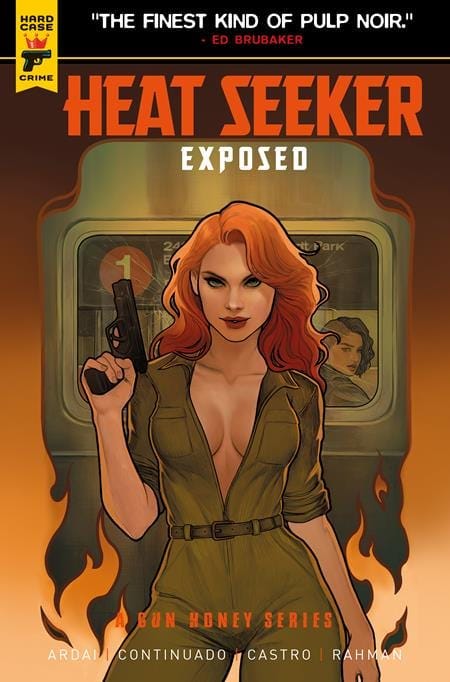
Heat Seeker: Exposed is the latest chapter in this series. Written and edited by Charles Ardai, with art by Ace Continuado, colors by Asifur Rahman, and inks by Juan Castro, the story once again follows Dahlia Racers, a fixer whose specialty is in making people disappear when the heat from those in pursuit gets too close.
This time, the danger is far more personal, as a relentless media influencer threatens to expose Dahlia in a story about how far one goes to exploit the truth, with more than the occasional whoops, the clothes came off moments that the genre is known for.
To talk about the legacy of pulp noir, the evolution of Heat Seeker, and the philosophy behind Hard Case Crime, The DeMonster caught up with Ardai for a conversation that delves into his earliest roots, while also exploring what the future holds in store for the publisher.
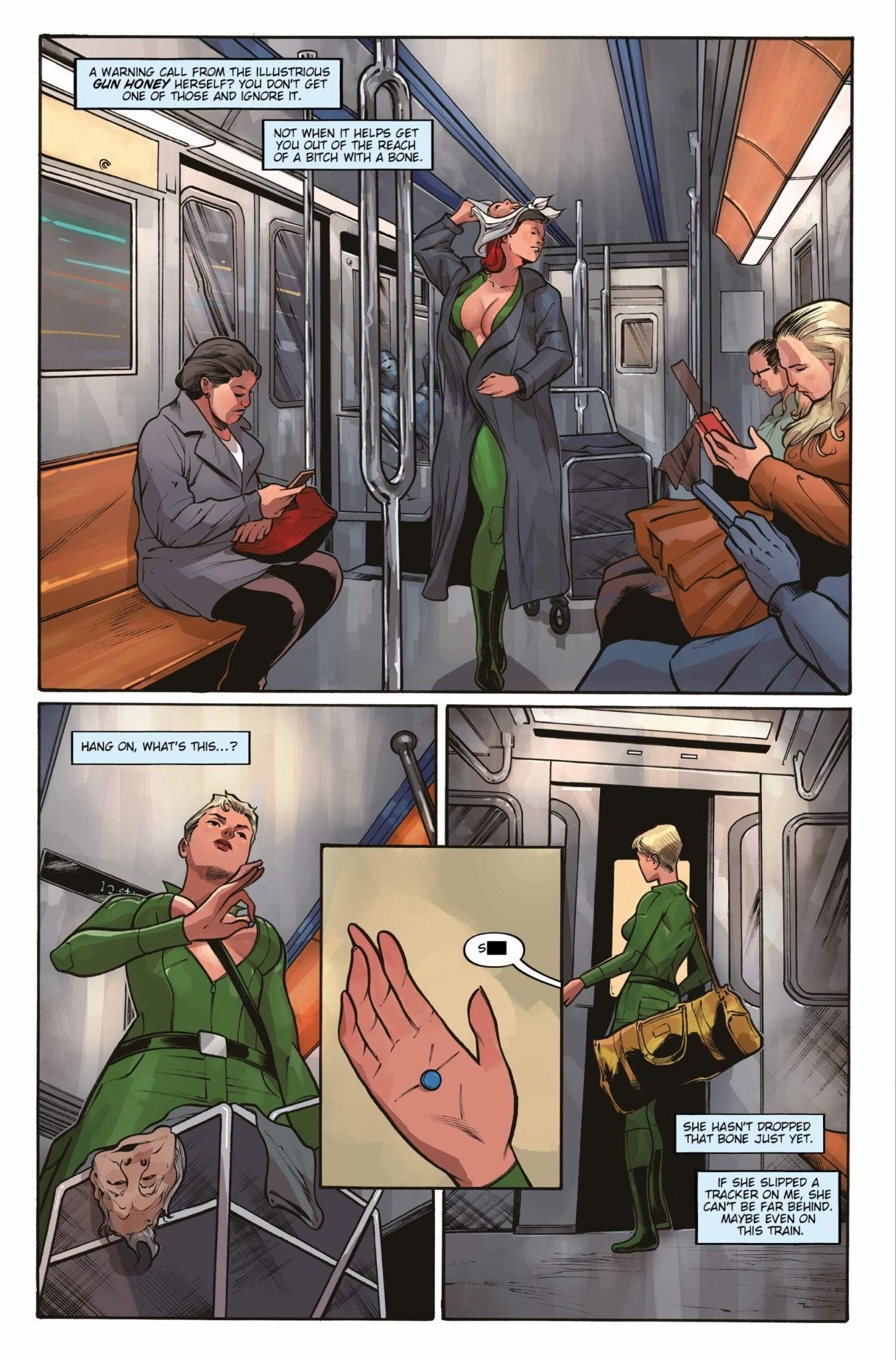
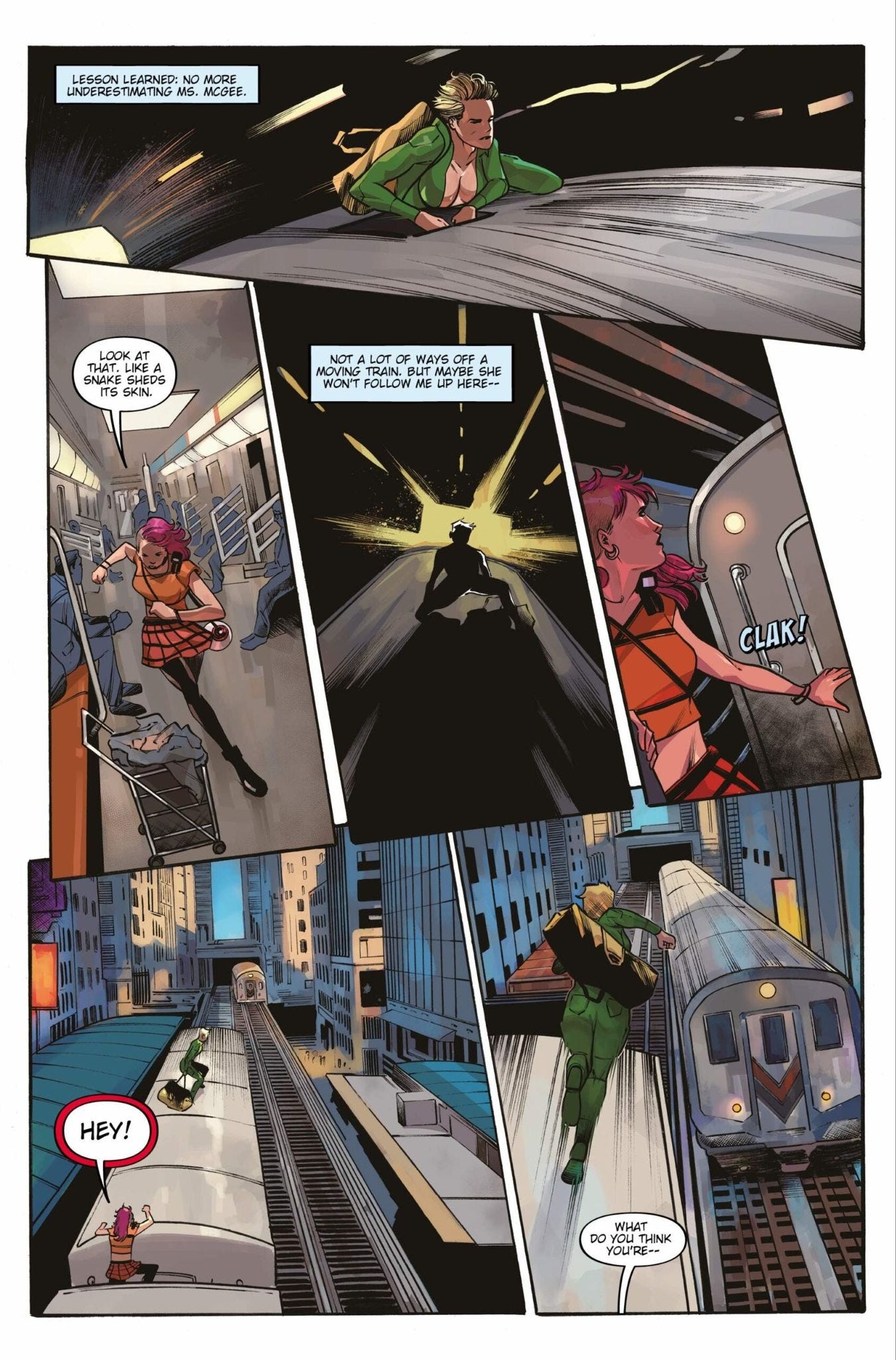
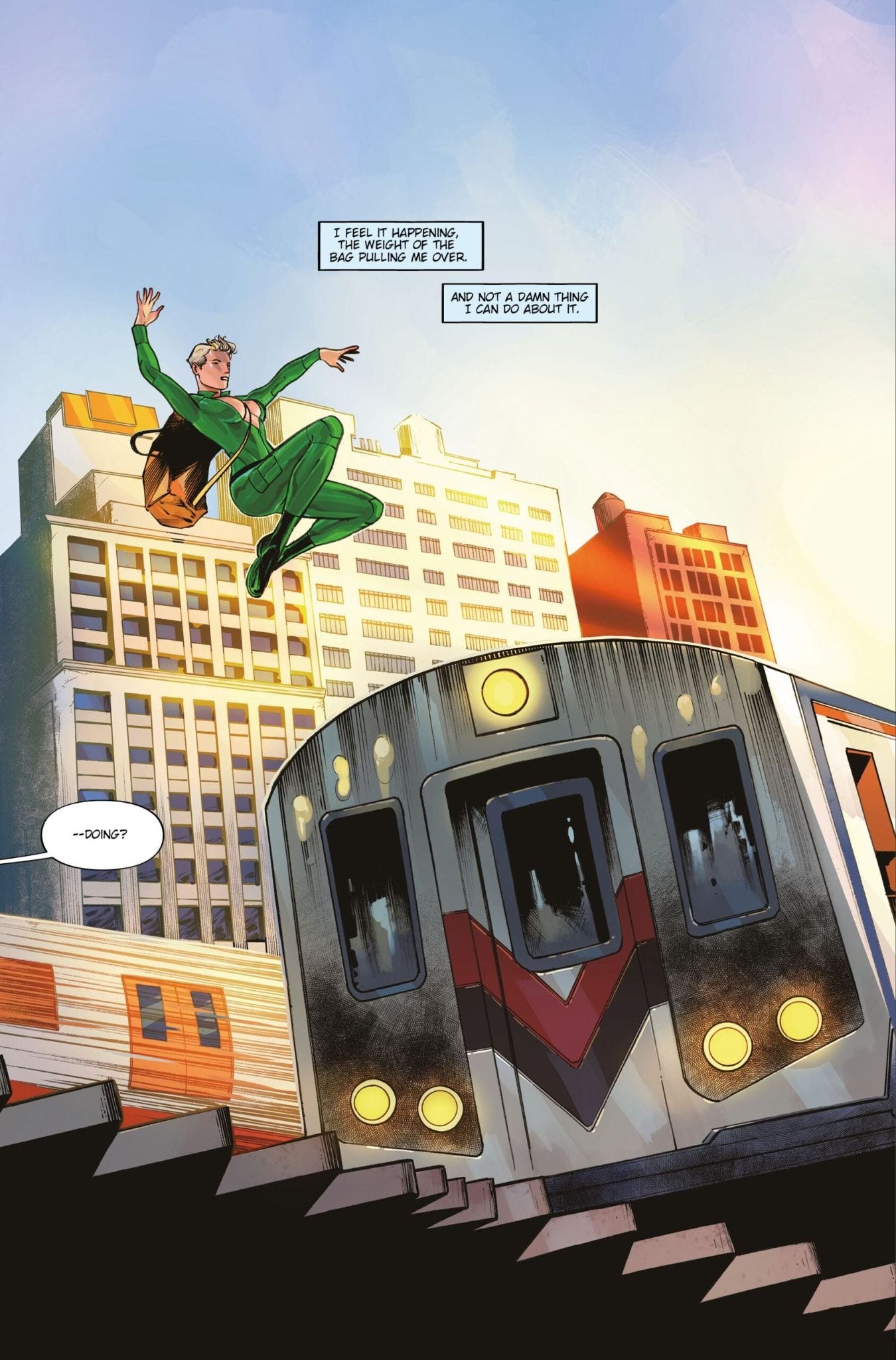
This interview was edited for clarity. Preview pages of issue one below.
I’ve read both Gun Honey and Heat Seeker: books bringing pulp noir to the modern era. Some critics have dismissed pulp as sex and violence masquerading as art, but in your own words, can you tell me what’s evolved over time? Similarly, what’s been preserved?
CHARLES ARDAI: “Sex and violence masquerading as art” is a criticism leveled against the likes of Ulysses, Lolita, and Lady Chatterley’s Lover – good company to be in!
But what distinguishes the best pulp fiction is that it’s actually the opposite: art masquerading as sex and violence. Behind all the two-fisted action and racy plots, the finest pulp fiction -- like the best work of Raymond Chandler or Dashiell Hammett or James M. Cain -- delivers serious, moving drama about men and women in crises, facing morally ambiguous situations.
And that’s the pulp noir tradition Hard Case Crime has worked to preserve: fast-moving entertainment that delivers more than just sex and violence. We want to give readers something that sticks with them after they turn the last page.
It works. Now, before this, you worked at one of the biggest hedge funds, D. E. Shaw, alongside Jeff Bezos. After that, you co-founded Juno, one of the largest internet service providers in the ‘90s. You were a dot-com era pioneer who walked away from it all to start Hard Case Crime. What made you leave the former to start the latter?
CHARLES ARDAI: It’s funny – I was a writer first, penning reviews for videogame magazines when I was a teenager and then short stories for Ellery Queen and Alfred Hitchcock. So really, it was the detour into hedge funds and technology that was the departure for me.
In college, I studied British Romantic Poetry, for heaven’s sake! I did enjoy the years I spent as a tech entrepreneur, it taught me a lot about how to run a business that I can use now when running Hard Case Crime, but really, my first love has always been writing and publishing, so it was only a matter of time before I yielded to its siren song and came back to it.
Interestingly, Jeff Bezos was a thoughtful reader when I knew him, with a genuine passion for books; in an alternate universe, he might have made a similar choice to mine. But different sirens called him, I guess.
Speaking of, you came up in a publishing era that rewarded patience and real editorial risk. When becoming a professional writer felt like a reachable dream. What do you think the industry has lost as it’s become faster, safer, and increasingly data-driven?
CHARLES ARDAI: I do feel like a dinosaur sometimes, since I remember the days before computers, before spreadsheets, when magazines had paste-up divisions where you coated strips of type with wax and stuck them to boards. Plenty is better now, plenty is easier, tools are more powerful – but it’s always a tradeoff, and what’s been lost, not always but too often, is the publisher who does what his heart tells him, not what the numbers say. Publishers want a P&L, a “costing,” before deciding to publish a book. I say, “Do I love this book?” Maybe you need both – losing money on things you love is a good way to go broke. But I hear less than I’d like to about love these days, about passion.
I’ll give you an example: a few years back, I read a book I absolutely adored (though the ending needed work – work I was happy to give it, since I still think working with an author to craft the words on the page is the first and highest responsibility of an editor), and I wanted to publish it, but I was told that the author’s previous books had had a downward sales trajectory, each selling less than the one before. The data-driven analysts assumed that his next book would sell less still, and were sure stores wouldn’t buy it in any meaningful quantity, so house after house had passed on the book, even though it was by far the best thing he’d ever written – in fact, the best book I’d read by any author in years.
So I bought the book, and I worked with the author to strengthen the ending, and the one concession he and I made to the data miners was that we came up with a new pseudonym for him, so that booksellers would be willing to give him a fresh start, as if he were a first novelist all over again. The result? The book got rave reviews, won the Edgar Award, and became one of our biggest bestsellers of all time. And it deserved to. But a dozen other publishers were too shortsighted or cowardly to give it a chance.
Publishing is a difficult game. Moreso now than ever before. But let’s get to it. Can you pitch us Heat Seeker: Exposed for the unfamiliar?
CHARLES ARDAI: HEAT SEEKER is a series of comic books about a criminal named Dahlia Racers, who, if you’ve been marked for death, will help you disappear and take the heat on herself in your place – for a fee. HEAT SEEKER: EXPOSED is the third storyline, and this time around, a persistent online reporter has gotten on Dahlia’s trail and is determined to expose her secrets to the world…so this time, the person Dahlia has to help disappear is Dahlia herself. You don’t need to have read the first two stories to enjoy the third – each is a standalone adventure. But hopefully, if you do read the third, you’ll be moved to pick up the others too!

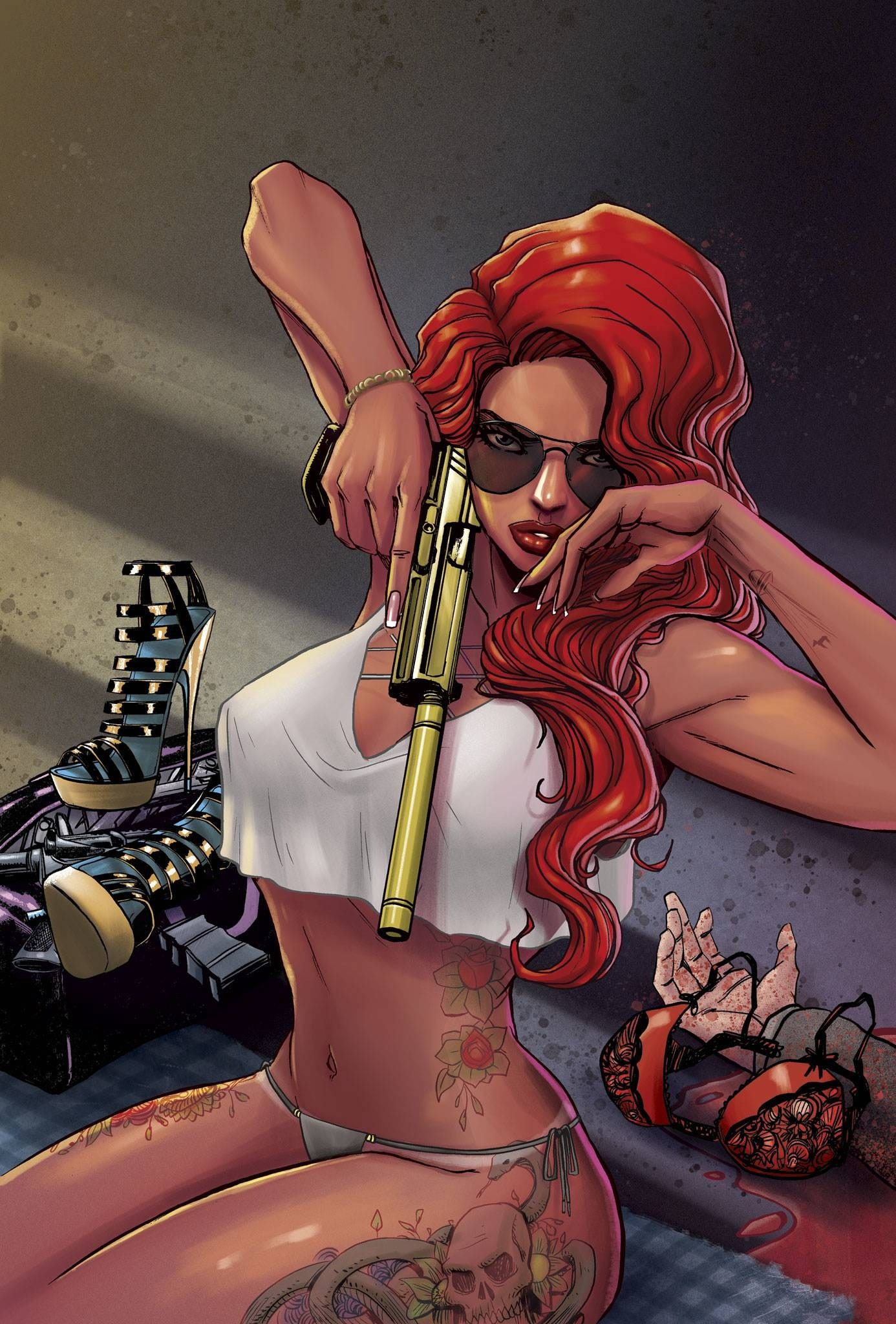
A signature staple of Pulp Noir is the covers. Gun Honey and Heat Seeker are known for it. You’ve got artists like Artgerm and Jamie Tyndall; big-time cosplayers like Grace McClung modeling, all in sexy pulp aesthetics. How involved are you in shaping these covers? Have any personal favorites you’re especially proud of?
CHARLES ARDAI: I am deeply involved in creating the covers and I love it – working with artists and models to come up with beautiful, exciting, and tantalizing covers is like dessert at the end of the meal, a treat I reward myself with after doing the hard work of coming up with the stories and writing the scripts.
My friends at Titan Comics have been instrumental in introducing me to many of our best artists, including Artgerm, but other relationships have started with me, like our work with Adam Hughes, Bill Sienkiewicz, and the late, great Robert McGinnis. I’ve had the fun job of shooting reference photos of models for our painters to paint from (and sometimes for publication), and I work with all our cosplay models, though really they deserve all the credit for coming up with those amazing images. (I have the easy job: sorting through all the different poses they send me and picking my favorites.)
As for picking personal favorites among all our covers, I can’t think of a better way to hurt the feelings of whatever artists I didn’t pick, so I should demur – but I do have to say that getting to work with Bob McGinnis, the painter of the posters for Breakfast at Tiffany’s and the original James Bond movies, was a once-in-a-lifetime thrill.
What’s that collaboration like when intentionally pushing into provocative territory?
CHARLES ARDAI: The most important thing is for each artist and model to be having fun. This is a chance to create the sultriest, most seductive femme fatale painting ever to appear on a book cover. If someone isn’t excited about doing that, that’s fine – our books won’t be everyone’s cup of tea. But for the right person, it’s a dream gig: the chance to create gorgeous pinup art so jaw-dropping that it will displace Jessica Rabbit or Sharon Stone in the audience’s mind. Of course, everyone has to set their own boundaries – some artists will paint nudes, some won’t. But within those boundaries, we encourage everyone to just have a blast and, in particular, not feel like we’re holding them back in any way from taking things as far as they would like.
Heat Seeker spins out of Gun Honey but shifts the focus on a fixer rather than a gun planter. Dahlia Racer has a job to get the heat off someone when they’re being pursued; essentially, clean up other people’s messes. All master of disguise and spy-drama affair. Where did Dahlia creatively come from?
CHARLES ARDAI: We’d just finished GUN HONEY: BLOOD FOR BLOOD, which ended with Joanna Tan – the titular gun planter – on the run from U.S. government agents who want her dead. The brilliant artist who draws GUN HONEY, Ang Hor Kheng, was going to need more than a year to draw the next installment, GUN HONEY: COLLISION COURSE, and I didn’t want readers to have to wait more than a year for the next part of the story, so I came up with the idea of doing a spinoff series with a different artist (the equally brilliant Ace Continuado!), featuring a different lead character who had a different criminal specialty. What would that specialty be? Well, Joanna desperately needed to disappear – so maybe the new character would be someone that could help her with that. How would Joanna know about Dahlia? I decided that they were ex-girlfriends. And with those two decisions, HEAT SEEKER was born.
Speaking of, Dahlia Racers has a long history of escaping and setting traps. You use misdirection, which is notoriously hard to do without alienating readers. What’s the biggest challenge in making sleight-of-hand feel earned rather than gimmicky?
CHARLES ARDAI: You’re right, of course – those Mission Impossible full-face masks that make you perfectly resemble another person (and, by the way, also make you sound just like the other person) are ridiculous. And I do use ridiculous disguises like that in my story sometimes. Is it a gimmick? Yes. But here’s the test I use: is it fun? Does it enable me to tell a story that’s thrilling and delightful and full of twists and surprises and will make the reader happy? Because if so, okay, I’ll tolerate a bit of gimmickry, and I think the reader will too.
I mean, come on – the giant boulder chasing Indiana Jones in Raiders of the Lost Ark? That’s pretty ridiculous. Indy going under the truck hand-over-hand while it’s being driven at top speed? Ridiculous! But you don’t care. In the moment, you love it. And that’s the key. Gimmicks used to prop up a lame story are lame. But when it’s a character you love and a scene you’re enjoying…all is forgiven.
Fair point. That said, why was Heat Seeker: Exposed the right moment to put Dahlia in a story where she has to fix her own crisis?
CHARLES ARDAI: Dahlia’s previous adventure, HEAT SEEKER: COMBUSTION, was a wild thrill ride with big stunts and international settings and a biological weapon doomsday device…for the sequel, I wanted to bring Dahlia back down to earth, give her an adventure with a tougher, grittier feel. More like back-alley street fighting. This time, instead of jumping out of a private plane and skiing down the Italian Alps with machine gunners in pursuit on snowmobiles, Dahlia is trapped on top of a New York City subway train that’s racing toward the Bronx. And making the stakes personal raised the level of tension – I wanted to see what Dahlia would do when everything she thought she could count on is taken away from her.
Without spoilers, Heat Seeker Exposed focuses on an investigative media influencer as the villain. What’s it like to shape a story around a character who’ll do whatever it takes to expose someone for the sake of her followers?
CHARLES ARDAI: We all know influencers who’d do anything for clicks, for followers, for clout. I think this is a distinctly modern type of villain, the self-made star who maybe started out with good intentions (maybe!) but got seduced by the dark side somewhere along the way.
Jacqueline McGee (whose name is a tip of the hat to the Incredible Hulk’s nemesis in the 70s TV show) doesn’t see herself as a villain – she’s exposing criminals, and that’s a good thing, right? But as we eventually learn, she’ll cross some pretty serious lines to get what she wants. She’s a wrecking ball, and when Dahlia finds herself in McGee’s path, she either has to disappear or fight back – quite possibly to the death.
I’m curious about Dahlia Racer’s girlfriend Evie Parker. She’s always making geeky pop culture references, especially Marvel-related, and even calls herself Logan because of this mysterious healing factor. You talked about positive fan reception so far… So, is Evie going to get her own story in the future?
CHARLES ARDAI: Oh, yes, Evie is definitely getting her own story! I just recently sat down to write it. She’s one of my favorite characters to write because she’s just as big a geek as I am. She reads comics, she quotes Star Wars and The Princess Bride, and in life-or-death situations, she thinks about the Kobayashi Maru. She also happens to be 6 feet tall, gorgeous, a professional soldier, and impervious to pain, heat, cold, hunger, and fatigue.
Okay, fine, she’s a bit much, I admit it. But part of the fun is to take this over-the-top trained killer and make her also a regular person at the same time. Master thieves also have favorite TV shows, favorite bands; master forgers are lactose intolerant, they catch colds, they have crushes; why couldn’t a master-level assassin also just happen to be a big nerd?
Gun Honey and Heat Seeker are unapologetic about mixing sex and violence, down to the naked women fighting. Where do you draw the line between what pulp noir demands of making it feel transgressive and stylish versus what crosses over into exploitation?
CHARLES ARDAI: It’s exploitation when characters are just puppets to feed the desires of an audience, when they don’t have a sufficient level of reality and independence and their own reasons for doing the things the story makes them do. And I think you know it when you see it – when female characters have their clothes ripped off just so a writer or filmmaker or an audience can leer at seeing them naked, and it feels like it’s at the characters’ expense.
In my opinion, it’s not exploitation when the characters have their own good reasons for doing what they do, when they’re proud of it, when they choose it for themselves and the hell with anyone who doesn’t like it. Joanna, Dahlia, and Evie are strong, independent women who aren’t ashamed of their bodies, they’re not shy about being naked when it feels right to them or it’s what they want to do.
They’re also proudly and openly queer, and when (for instance) Dahlia and Evie fall for each other while going through a grueling ordeal, they are by god going to celebrate their survival by going to bed together, and they don’t see any reason to apologize for it -- and neither do I. My goal is just to give the characters enough reality, enough substance, that you believe they’re making their own choices.
A lot of writers still believe talent alone will get them noticed, the way many of us once believed writing itself was the end goal. As an editor, what’s the hardest truth about breaking in today that most writers don’t want to hear?
CHARLES ARDAI: That publishing a book isn’t crossing the finish line, it’s the starter’s pistol going off. Yes, selling a book to an editor is hard enough: a ton of competition, the struggle to write something good and make it better, the need for networking and making contacts and writing persuasive pitches, and all the rest. But the truth is, once you do sell a book – or choose to self-publish one, which is now a pretty decent option – you then have to find a way to get some attention for it, or it’s going to disappear without anyone ever noticing it.
There used to be far more places to get books reviewed – there were book review sections in newspapers and magazines, books were sometimes covered on radio and TV, but those traditional media outlets have withered, and while, yes, there’s BookTok today and the like, it’s an enormous challenge to find and reach out to and persuade the people who have the ear of the world’s readers that your one book, of all the tens of thousands being published this year, is worth an hour or two (or three, or ten) of someone’s time.
As a writer, you want to go back to your word processor and start hammering out the next book – that’s the job, right? But these days, half the job (sometimes more, it seems) is not the writing itself but the promotion, the ceaseless battle to carve out just a little bit of attention for the product of your soul that you’ve somehow, at great pains, managed to coax into existence.
And the brutal truth is, most of the time it doesn’t work. Most books do sink, unnoticed and unheralded. But you have to keep trying. If writing is what you want to do, it’s like being a fighter. You’re exhausted, you’ve gone ten rounds, but you have to climb into the ring again and keep throwing punches.
So true. Now to ask something fans of the series want to know: are we ever going to get a full-volume crossover between Gun Honey and Heat Seeker?
CHARLES ARDAI: I’d love that. And it’s kind of a natural: someone hires Joanna Tan to plant a weapon to kill a character who gets wind of the plot against him and hires Dahlia to help him disappear. Joanna’s job is to make sure this poor bastard dies, and Dahlia’s job is to make sure he survives. The two exes are up against each other. Only one can win. Who will it be? As soon as I’m done writing Evie’s series, I think that’ll be the next thing I write.
Finally, any updates on the Gun Honey TV show in development?
CHARLES ARDAI: There’s a pilot script, there’s a writer’s room, all the episodes for the first season have been spec’d out, there’s a budget, we’re set to film across several countries in Asia, the producers are raring to go – all we need is the funding. But that’s what every production needs, and when your IP is a successful comic book series but not Spiderman successful, not Superman successful, you have to convince the people who hold the purse strings that it’s worth the investment, that fans will show up if you put Joanna Tan’s deadly adventures on the screen. I believe they will – but do the people at Netflix or Amazon or Apple or wherever believe it? They haven’t written the check yet! But it took, what, 15 years for Lord of the Rings to get made? These things take time. I’m just the writer. Let Hollywood do Hollywood. I’ll just keep getting in the ring and throwing my punches.
_____
Heat Seeker: Exposed Volume 3 is available in comic stores and wherever comics are sold this April 14th.
Thank you for running this interview! Just one item that needs correcting: colors for HEAT SEEKER: EXPOSED are by Asifur Rahman (and inks by Juan Castro). Credit where credit is due!