

“Penny and the Yeti” is a Lifeline for Kids with Separated Parents
A children’s graphic novel that understands what kids notice long before adults admit it

Disgust is the final emotional precursor between partners before a broken marriage. Not anger. Not sadness. Disgust. You’ve likely seen it at some point in your life. The withdrawal. The eye roll. That guttural spew of repulsion in just seeing the other person. Before I became a journalist, I was a mental health specialist. And in my schooling, I remembered some research on this subject that’s been around since the 90s.
In several longitudinal studies conducted with the Gottman Institute, Psychologist John Gottman spent about four decades studying the nature of marital couples and why couples indeed split. What he found was that contempt and the disgust it breeds are strong predictors of divorce. That at some point, fighting becomes less about the subject on hand and more about these powerful emotional reactions against the other partner.
Penny and the Yeti explores the turmoil of this emotional world but in a book for kids. It tells the story from the kids’ perspective, showing how children feel and react when their parents are still together but clearly unhappy, and the quiet tension that children notice and live with when their parents are constantly fighting.
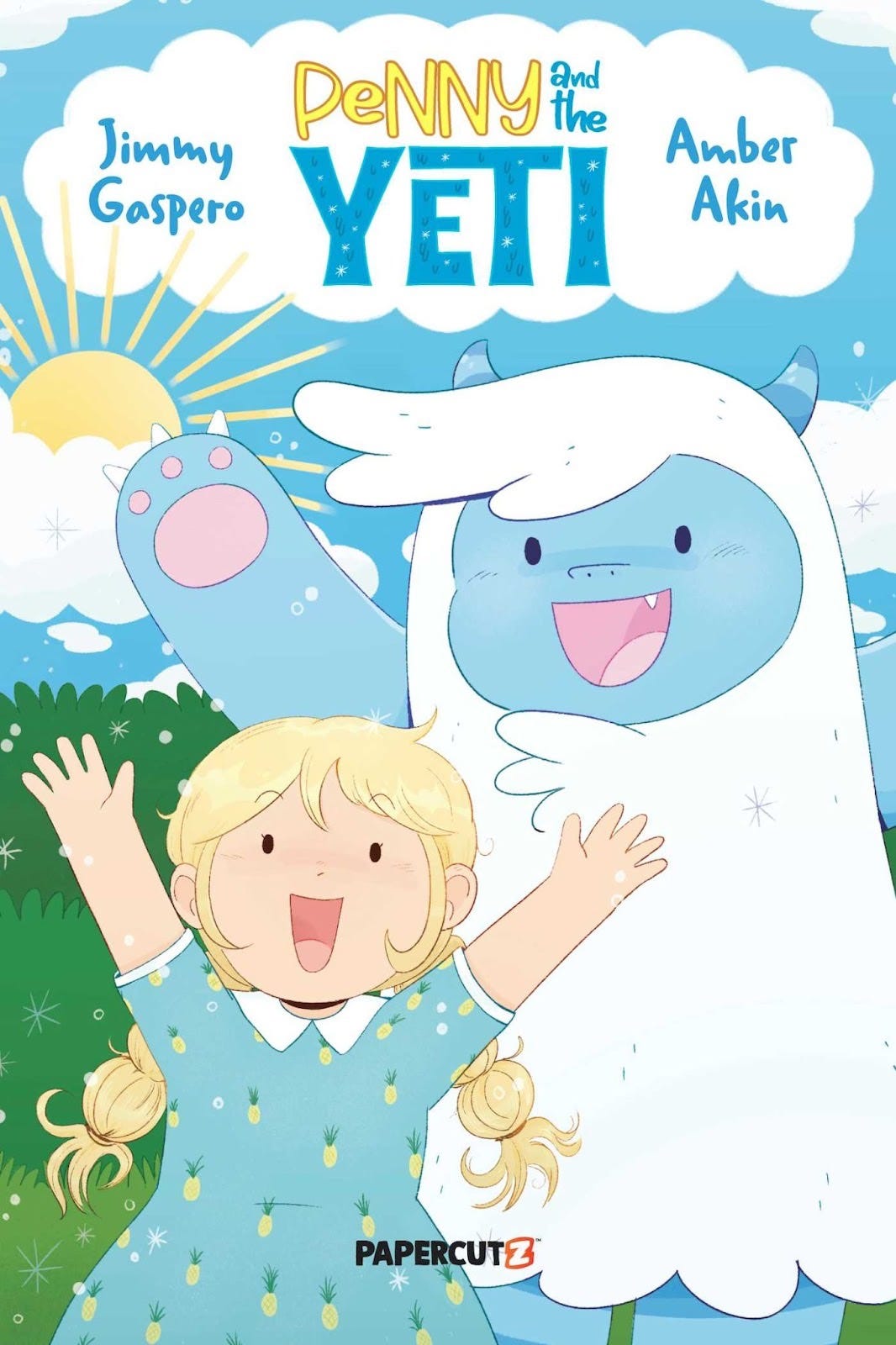
Written by Jimmy Gaspero and illustrated by Amber Akin, what makes Penny and the Yeti a deceptively simple but very powerful read, is that it examines the life of a young girl who is growing up in a home defined by constant, low-grade conflict. How that traumatic experience can shape how kids figure themselves out despite not having the language to know what’s wrong; only processing that something feels broken at home.
How they do it is with a magical Yeti, who enters the world as an imaginary friend made manifest, born out of a drawing by Penny’s older sister, Peri. With Yeti’s help, the kids go on several quests to try and fix their parents’ relationship, essentially pulling a pseudo-version of the Parent Trap, so that Penny can try to make things better.
Personally, I loved this book. As a former professional and someone who used to do early-childhood intervention, this book works because it delves into the complexities of parental-relationships despite its simple kiddie premise. More importantly, this book refuses to throw a blanket blame, showcasing in a neat little story that Penny’s parents aren’t monsters. They’re mismatched and exhausted. A Type-A mother and a loving but overworked father who is very glued to his phone.
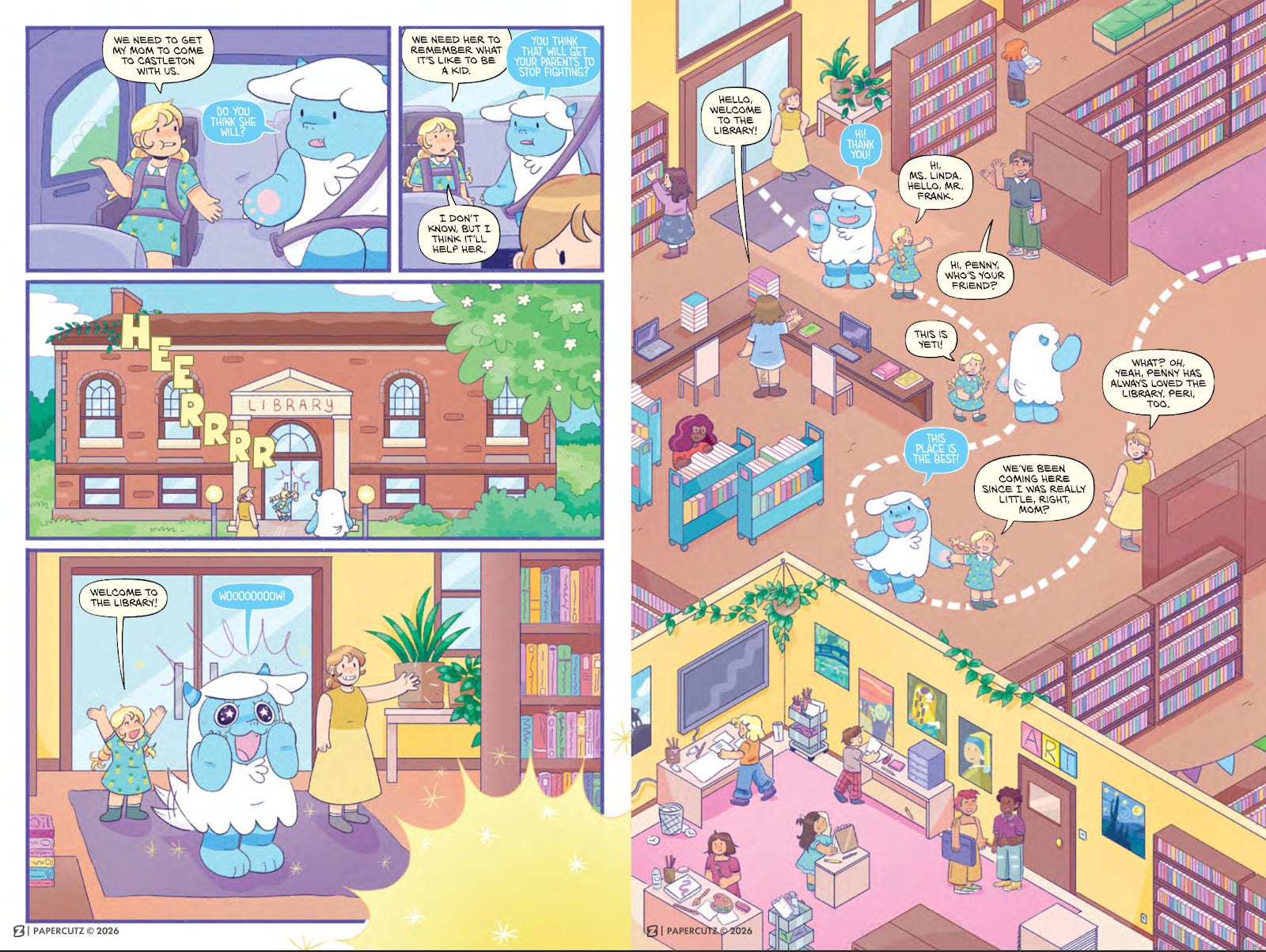
Dutifully drawn by Amber Akin, this artwork elegantly supports the emotional seriousness without softening it; cute but not empty. And perfect for kids while conveying a powerful message. The pages go at it with warm pacing that’s smart and reminiscent of kids’ Sunday comics or illustrated kids’ lit, with tracking walking shots that reminded me of Peanuts comic strips, but also time jumps, skip transitions, and a fluidity that works because of its Yeti friend.
Yeti is thus the heart of this book. A gentle giant who’s patient and emotionally supportive. A strange yet adorable Mary Poppinsesque figure that is holding our reader’s metaphorical hand, and someone who’s earned the reader’s trust to follow. In lieu of fixing everyone’s problems, the Yeti serves as emotional support for a kid who needs stability more than answers.
He’s also quietly radical. A “him,” but who denies being stereotyped as a monster. Someone who’s both openly nurturing and unconcerned with gendered kids’ norms, as you’ll see regarding a moment of play and a princess. The scene isn’t flagrant or explained. It just exists. In an authentic way, with a script that I’m thoroughly impressed with by Jimmy Gaspero.
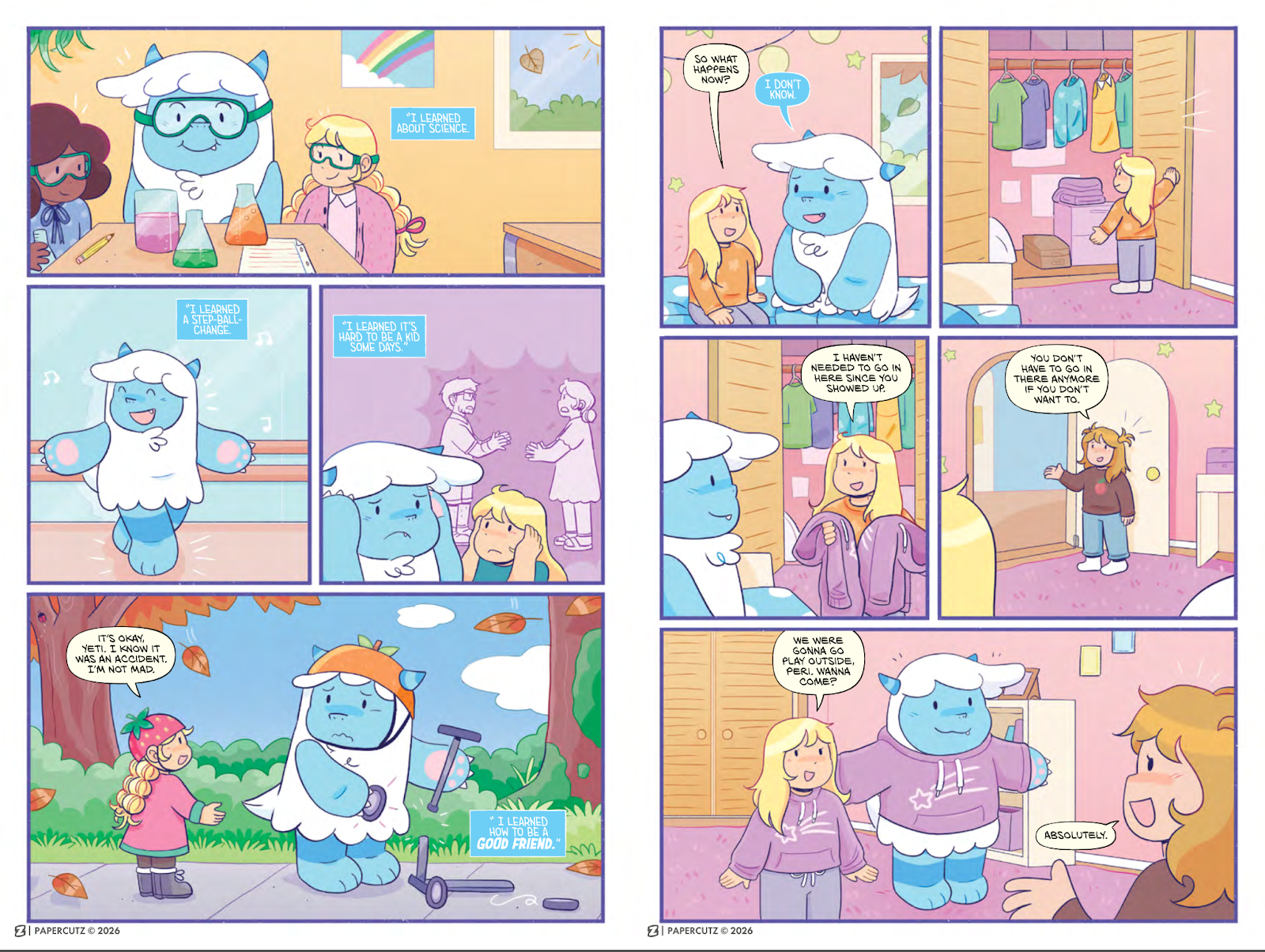
Overall, Penny and the Yeti is a reassuring book that addresses separation. It tells kids they aren’t responsible for their parents’ problems and that they can still grow, and still be okay, even when the adults around them aren’t. And yes, I could end this review there… but I’d like to try something different.
And talk more about the craft of this Papercutz book with its creators.
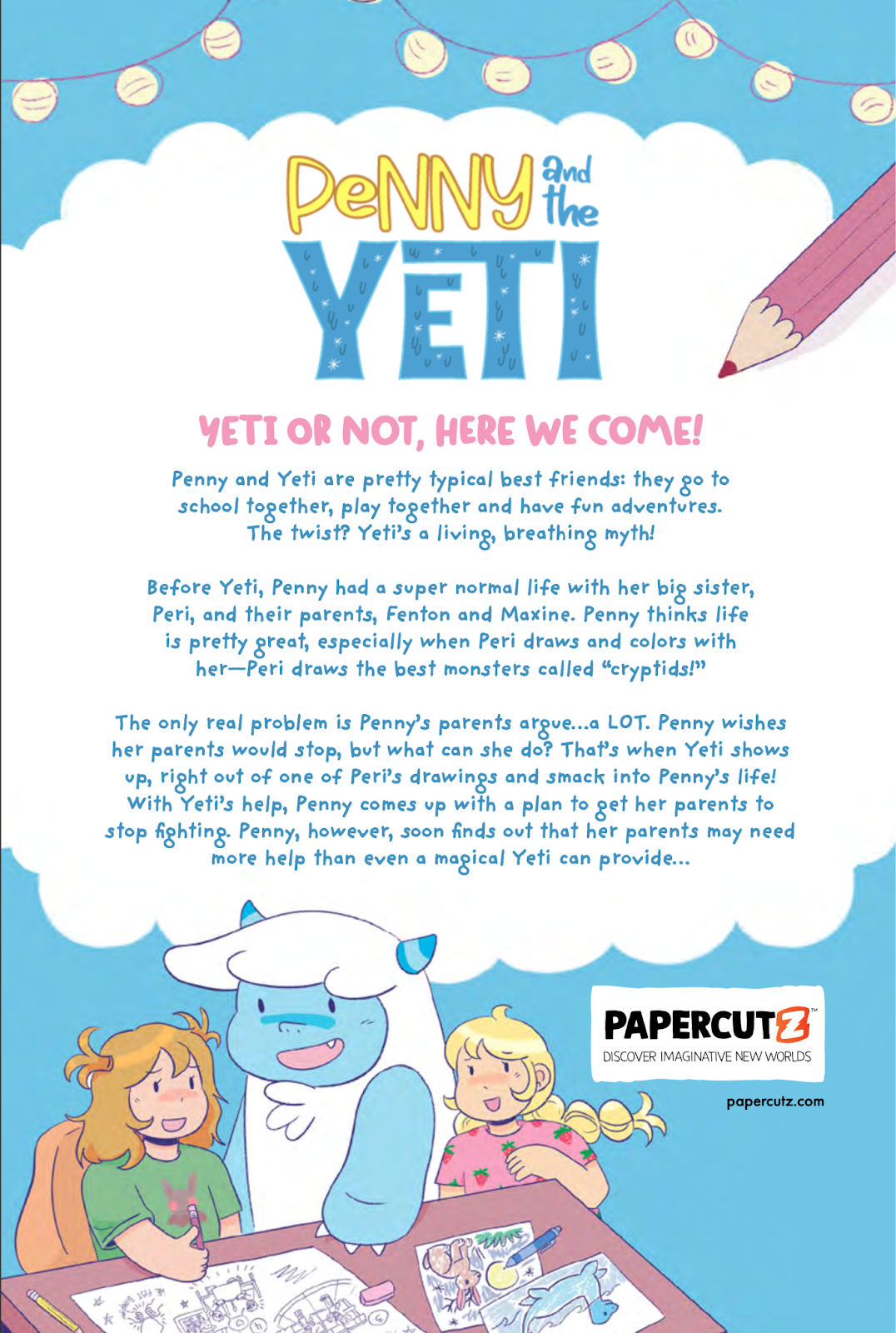
A review turned into an interview. Don’t see this very often, but I thought, let’s try something different. Jimmy, you’re one of the best modern voices interviewing comics creators and supporting indie comics. The co-host of the Comic Book Yeti podcast with Byron O’Neal. I’ve gotten really into this book already, but…
Can you tell us more? Why’d you feel this was a story you must tell?
JIMMY GASPERO: Penny and the Yeti started back in the Summer of 2022 with an idea that me and my own daughter Penny (she was 5 at the time) came up with about a young girl and her friend Yeti. Her friend was a Yeti because of my work with Comic Book Yeti and that Penny likes Yetis. I found Amber through Beck Kubrick to draw, color, and letter a 4 page short called Yeti and the Big Stomp (most of which can be found in Penny and the Yeti). When it came time to tell the larger story I was thinking of stories where kids deal with the aftermath of divorce, which I have seen plenty of those. I wanted to tell a story where Penny and her sister Peri were in a situation where the parents are in conflict and how the kids try to navigate that. I also wanted to tell a story about kindness and empathy and I hope readers will see that in the friendship of Penny and Yeti.
What was Yeti based on or inspired by?
JIMMY GASPERO: The character of Yeti is purely one of Amber’s design. I think she sent me what she was thinking and Yeti looked big and safe and friendly. In terms of the story, to add on what I wrote above, some of the issues Fenton and Maxine have are based on my own relationship with my wife Sarah and things I’ve heard from friends, those small arguments couples get into that often snowball into something more.
AMBER AKIN: I initially looked into the ways other people had already drawn cute yetis. With the most recognizable, readable version of a yeti in mind I brainstormed ways to add some uniqueness to Yeti’s look. At first I was most influenced by Sulley from Disney’s Monsters, Inc. This was a character that I adored as a child, an intimidating yeti-like monster with a gentle heart who ends up taking care of a little girl- perfect inspiration! Instead of Sulley’s spots I gave Yeti stripes, and in a personal addition I gave him a bit of a catlike flair with toe beans, paw pads, and horns that emote like cat ears. I wanted a good mix of cute, recognizable, and quirky- which I think I was able to achieve with Yeti’s final look!
Amber, you’ve been a kids illustrator for years. How’d you end up working on this project? What drew you to Penny and the Yeti?
AMBER AKIN: Jimmy and I were actually brought together by a social media mutual of ours! I’d love to give cartoonist and writer Beck Kubrick (Masks, Dead Girls) a shout out. Without their recommendation, I would have never had the incredible joy of drawing Penny and the Yeti. Thank you, Beck! Originally, Penny and the Yeti was a short 4 page story written by Jimmy and his daughter Penny. It was exactly the sort of thing I wanted to be drawing–a playful, quirky story with heart. Plus it featured a friendly magical creature, heck yeah! I had a lot of fun drawing those original pages, it was the first time I returned to professionally drawing comics after graduating college during the pandemic. Jimmy reached back out some months later asking for my permission to send those pages out with a pitch to Mad Cave. After reading the synopsis of what would become Penny and the Yeti, I was fully on board! I work full time as an educator when I’m not drawing, and I think a story like Penny and the Yeti is important for children to have access to.
Jimmy, I noticed your daughter has the same name. Why is that and was there anything here pulled from your own experiences as a parent?
JIMMY GASPERO: For the first 4 page short Yeti and the Big Stomp in 2022, it started one night when I was putting Penny to bed. I asked her if she had any big plans for that Summer. She looked at me as to why was I asking her what her plans were and said no. She then asked me if I had any plans and when I said just work she told me I should write a story. I said what about and she responded “A Yeti.” So as she was falling asleep we came up with an idea and I thought it’d be fun to script it and hire an artist and show her how comics were made. That’s how the character of Penny was created. I think there’s quite a few things I’ve pulled from my own experience as a parent. It’s hard. Sometimes I forget how much my kids pay attention to everything, how much they observe, how much they soak up. I didn’t want Fenton and Maxine to come across as bad parents. I think they represent a lot of parents I know. Fenton and Maxine are stuck in this pattern and they don’t know how to break it. At the same time, Amber and I didn’t want to create a story where the kids and Yeti are responsible for the parents’ relationship and we didn’t want to create a story where everything is magically fixed by the end.
This book depicts marital strain but without labels. Why was it important to approach the subject in a neutral space, especially for younger readers? (And I mean this both regarding the heavy subject material, but also, the artwork that dutifully focused more on the kids rather than details of the couple arguing.)
JIMMY GASPERO: This is a family. There aren’t heroes and villains. There isn’t an easy, quick fix. Kids are perceptive. Often a lot more perceptive than adults give them credit for. I didn’t want the story to feel inauthentic. I think approaching it in a neutral space was key to that. I will also say, as for Amber’s artwork and colors, pulling focus to the kids and Yeti and their expressions helped immensely to tell this story from the kids’ perspective. Amber crushed it.
AMBER AKIN: Giving young readers a safe opportunity to have their own experiences validated, reduce any shame that children might feel in regards to their own family’s conflicts, and build empathy is very valuable in helping them navigate a complicated world. Every time I drew Max and Fenton having a spat, I wanted to make sure that Penny and Peri’s reactions were centered because it is less about the fighting, and more about the emotional toll it takes on the children and how they navigate those negative feelings.
Amber, given the material yet ability to balance the kid-friendliness, what would you say was the most challenging part about creating this book?
AMBER AKIN: While drawing Penny and the YetiI I had to be sure that readers have the opportunity to find empathy for all of the book’s cast and show the characters’ humanness (and yetiness) through body language, staging, expression, and color language. It was difficult at times to keep the parents’ arguments from being too scary, or too palatable, and achieve a level of discomfort appropriate for young readers. The story is ultimately for children to experience and process a family dynamic like Penny’s in a safe environment, with a Yeti to guide them through the hard parts. I had to make the art comforting and playful when it needed to be, and uncomfortable when it needed to be- which was both challenging, and rewarding.
What do you hope readers take away from Penny and The Yeti?
JIMMY GASPERO: I hope readers enjoy it. I hope they have fun, especially with the imagination and playfulness of Penny and Yeti. I hope any young readers know that if they are going through something like Penny and Peri, they can talk about it with the adults in their life that care about them. I hope readers see the kindness and empathy in Penny and Yeti’s friendship and maybe pay a bit of that forward.
_________________________________________
You can get a copy of Penny and the Yeti wherever graphic novels are sold, with a final order cutoff on 3/30/2026, so you can still ask your shop about it now.

Christian Angeles is a writer and entertainment journalist with nearly a decade of experience covering comics, video games, and digital media. He was senior editor at The Beat during its Eisner Award–winning year and also served as managing editor of The Workprint. Outside of journalism, he writes comics and books.
 | A guest post by
|