

The Road to Hell is Paved with Good Intentions: Interview with Anna Meyer on “Saint Catherine”
This is a book about faith, guilt, and finding yourself in your twenties.

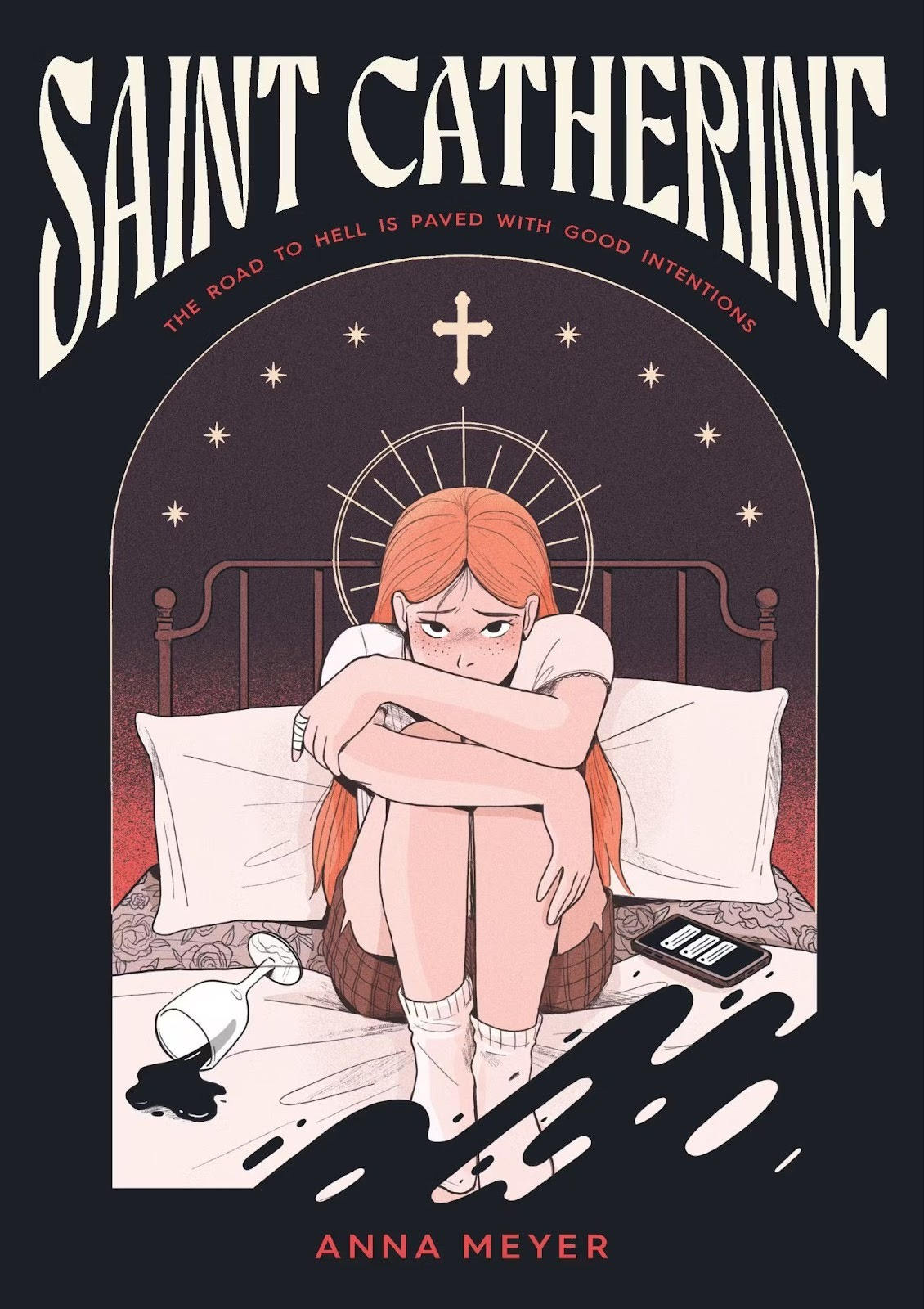
Growing up in a strict Catholic household, you’re taught that sins and breaking religious ritual lead you to going straight to Hell. Especially if you don’t follow the rules. But what if skipping Sunday Mass came with… consequences? What if the guilt of missing church for the first time could actually lead to demonic possession?
That’s the wickedly clever premise behind Saint Catherine, author and illustrator Anna Meyer’s heartwarming and haunting graphic novel debut. Originally debuted on Webtoon Canvas, then later published by 23rd Street Books, this is a book about faith, guilt, and finding yourself in your twenties. A true coming-of-age, losing faith but finding yourself, type of story.
Saint Catherine follows the tale of a 20-something Irish-American Catholic trying to outgrow her traditional upbringing, all while juggling work, love, and friendship. A homely tale as equal parts demonstrably chaotic as it is deeply honest, Saint Catherine turns religious trauma into something raw and unexpectedly comforting.
At NYCC, I met writer-artist Anna Meyer at a party for 23rd Street Books. Together, we talked about faith, demons, and the fine art of turning guilt into coming-of-age comedy… and more.
This interview was edited for clarity.
You and I both went to Catholic school, but for you, there’s almost a symbolic reverence to it. Lots of Catholic imagery in here with saints, demons, confessionals, and mass. Can you talk about growing up with this mythos and what was so important about it to you?
ANNA MEYER: I’ve always loved the supernatural and fantastical from a young age. It was very important to my parents that their children were good Catholics. As a child, I wanted to please my parents, but it felt easy because there’s something about Catholicism that is so inherently magical. The saints, angels, demons, and miracles. As a little girl who daydreamed about waking up with the same superpowers as Kitty Pryde, I wanted to believe these things were real. It was a form of magic that the adults in my life validated. I also find the music and visuals of Catholicism to be so moving. My fixation on religious imagery is both aesthetic and nostalgic.
For Saint Catherine, I wanted to highlight all of these things. How the stories of the saints are inspiring, but also deeply morose and macabre. How a Catholic church can feel as peaceful as it is foreboding. Religion can give some peace and purpose, while for others it only fosters fear and paranoia. I wanted to address the realities of religion and how it can affect our psyche, while also treating it as a mythology akin to how we view the mythos of Olympus, etc.
I gotta ask because of our Catholic upbringing guilt, was it important to address this tastefully out of respect for folks who still practice?
ANNA MEYER: Overall, I never want my stories to feel like a lecture. As a writer, there are a lot of goals I’m trying to achieve, but my top priority is usually my characters. I want the reader to understand them, whether they agree with them or not. To understand Catherine and her mother, you have to understand why people turn to religion. For Catherine, it is fear; for her Mother, it is purpose. While this story definitely touches on a broader conversation around religion, I always say it’s more about how religion affects the individual.
I became an adult in the early 2010s. The era of sardonic, atheist YouTubers and jokes about The Flying Spaghetti Monster. And I just find that approach boring and anti-human. I’m much more interested in exploring why people believe what they believe and what they do with it. I don’t want to gloss over the harm that religion has caused. Especially now, as we watch Christianity being used to justify violence and oppression. But I don’t want readers to feel like they are stupid for believing at some point or currently.
What did you want readers, especially those who aren’t religious, to understand about how manifested guilt shaped Catherine’s identity?
ANNA MEYER: I really wanted to show what raising someone from a young age to believe in eternal damnation does to a person’s psyche. How harmful it can be. How it causes not just intense guilt, but also paranoia. If you believe from a young age that an omnipotent being can not only know what you did but also what you think, how can you not develop a strange sense of paranoia? And the guilt comes from a fear of punishment, which can then lead to navel-gazing. At what point is a focus on morality about your own self-preservation rather than a desire to do good? And that is what Catherine is unpacking throughout this story.
In your opinion, Faith and Fear… are they friends or are they frenemies? Why?
ANNA MEYER: Regarding religion, frenemies. I think so many religions nowadays utilize fear under the guise of faith. In its purest form, faith is a beautiful thing. Being able to have trust in yourself, your friends, your family, etc, is a privilege. But faith has to be earned. That’s something the characters in this book learn over time.
Next, let’s talk art. The flashbacks are in traditional black and white, and the present, orange hues. Why the color changes?
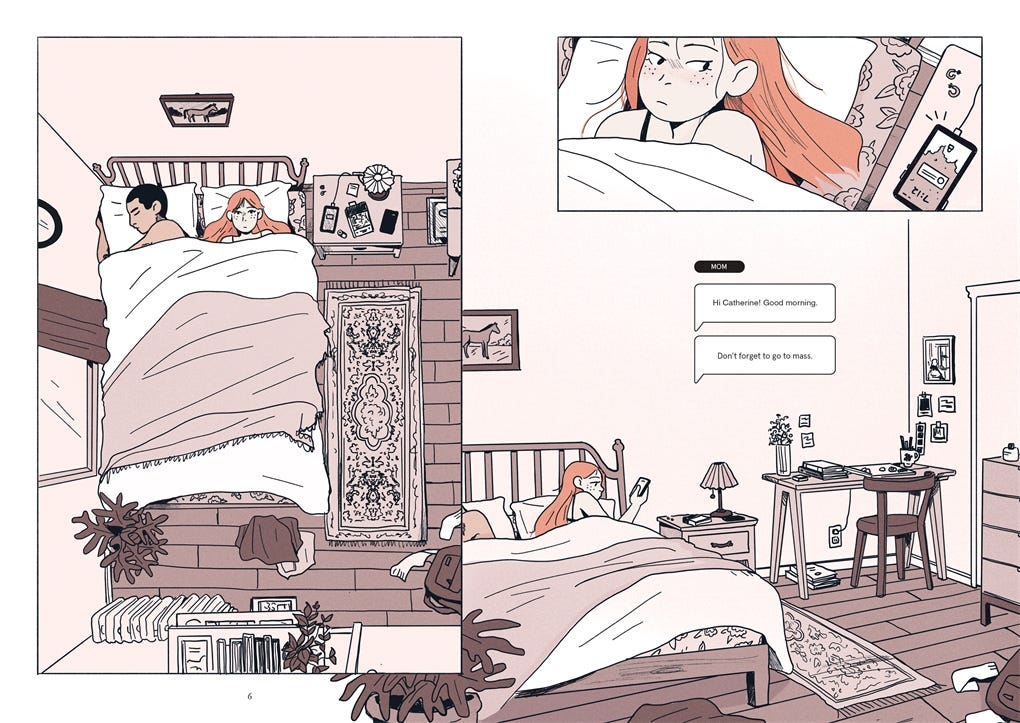
ANNA MEYER: Most of the flashbacks take place 1-2 years before the present story. I didn’t want to just rely on a date and a haircut to show the time difference, so a clear color change was the best option. I also love how it makes the flashbacks feel hazy, like a memory. I used a limited color palette for this story because, aesthetically, I love a limited palette, and also, it is less time-consuming to color. It’s a lot of work up front to choose the colors that will work seamlessly throughout the book. But once you have a system, you can find a nice flow state.
I’d say I’m very proud of my color system. I don’t love coloring; it’s my least favorite part of the process, actually. So I was very nervous to color this book. But I approached it the way I do my design projects. When I pick a color, it’s not just for contrast or aesthetic, it has a purpose. The reds represent hell, demons, and anxiety. While a pale, golden yellow represents the saints and the heavenly realm. Similar to the way icons use gold leaf to show heaven instead of depicting it.

You did design for years before making this book. Did that experience and picking up new skills along the way influence your process at all?
ANNA MEYER: Yes, I’m very grateful for my design career because it really helped me in the making of this book. It taught me to set schedules and timelines, which kept me on track. It also allowed me to work on the InDesign file of the book in tandem with drawing it. I would typeset the dialogue and export JPEGs of the pages to overlay in my Procreate files. I started this in the pencils phase and did it throughout the whole process from there. That way, when I was structuring my panels and speech bubbles, I knew exactly how much space I needed. There’s also just something so exciting about finishing a penciled page, or an inked page, and placing it in the InDesign file. You get to watch the book come to life. It was motivating when I would feel overwhelmed by the workload of drawing an entire book.
Saint Catherine started as a webcomic and then became a trade paperback. What was that journey like, and did changing formats affect the storytelling?
ANNA MEYER: I always intended Saint Catherine to be a printed book. I just thought it would be self-published. So, going from a webcomic to a trade paperback didn’t change much of the storytelling aside from the benefit of getting a redo. I like to look back and think of the webcomic version as a first draft.
Getting a book published was always a dream of mine, but that felt like step 10, and I was on step 1. I had never even completed a full comic. I grew up on webcomics and started two of my own that I never finished before Saint Catherine. So I made it a goal of mine to start a webcomic and finish it. Once the webcomic was done, I would print it myself, and THEN I would worry about tackling the world of publishing. I felt there was no way a publisher would consider working with me if I couldn’t show that I can make a full book. I was posting weekly pages of Saint Catherine for maybe about 6 months, and then I discovered Webtoon. I would post the weekly pages to my website, and then I would reformat the panels for Webtoon. Somewhere around page 170, my editor found Saint Catherine through my Twitter, and reached out to me to pitch it as a graphic novel. I still can’t believe it.
Again, there are small story changes, but the overall structure is the same from the webcomic days. The big change is color! Like I said earlier, I was so nervous about coloring this book. The webcomic was black and white for that reason (plus I just really like black and white comics, would love to see publishers embrace more B&W). But my editor said it needed to be colored. I’m glad she did because color is something I’ve seen a lot of readers love about this book.
There’s a moment at the midpoint where Catherine and her mom argue about doing what makes you happy versus doing what’s morally “right.” Can you talk about that conundrum?
ANNA MEYER: This is a book about religion, I’m not being coy about it. But I didn’t want to alienate any non-religious readers. I think the challenge of doing the right thing is a human one, not a religious one. Religion has just convinced many people that you need it to know the answer to that question.
One of the things I wanted to show in that scene is how hard it can be for two people to communicate who are coming at an issue from such different places. One from unshakable faith and another from uncertain anxiety. And the frustration that brings.
Sometimes in stories, we see parents and children struggle to communicate, but they ultimately find a way to see eye to eye and resolve their issues. Or it ends in a severing of the relationship entirely. I wanted to write something about the in between. An argument that is never resolved, the frustrations that go unsaid.
Parental pressure is something many people can relate to, religious or not. Sometimes growing up means learning who you are outside of parental expectations. You might never get that sitcom heart-to-heart, and that’s ok.
Were there moments you hesitated to include because they felt too personal?
ANNA MEYER: Not really, since it is a fictional story. And I felt like the moments that reflected my own truth were not unique to me. The only character I worried about was the mother because that is the character that is the closest to a real person, being my own mother. I tried to handle that character with care and nuance, while also being truthful. I always try to do what’s best for the story, and I found the more truthful I was with the mother, the more resonant the text. And while I maintain they are very different in a lot of ways, my mother has been very understanding. While she has chosen to not read the book, she has been very supportive of my career as an author. I respect that. And we don’t talk about it much; it’s all very Irish-Catholic of us.
I think a big reason Catholics feel so much guilt is that so much of the faith sees suffering and self-sacrifice as something honorable or glorified. Do you think that’s true, and can you tell us how St. Catherine intentionally breaks that?
ANNA MEYER: Yes, suffering is absolutely glorified in the Catholic church. The saints are bastions of suffering. I think it all comes down to the desire to find meaning in pain. It’s only natural. I think that’s why people are so fixated on karma nowadays. It gives you a feeling of control. From an institutional standpoint, it’s a means of control. If the oppressed believe their suffering has a deeper meaning, they’re less likely to question their oppressor. It causes some to accept the status quo and even seek out more suffering to prove their worth. The concept of heaven relies on this. “Blessed are those who are persecuted because of righteousness, for theirs is the kingdom of heaven.”
But it can be funny sometimes how that mindset can manifest. The first time I went out to dinner and my date insisted on ordering a bottle of wine for the table, I felt like I was going to break out in hives. Something deep in the recesses of my brain told me it was too indulgent, too showy. I insisted we get glasses of wine instead, which ended up costing more than the bottle. In Saint Catherine I wanted to explore that feeling, and contrast it by celebrating the small moments that make life great. Pouring your heart out to your roommate on the bedroom floor. A fresh cup of coffee. A first kiss. How the air feels right before a storm. I really wanted to uplift those moments. And there’s no guilt in enjoyment. Make a fresh cup of coffee; order the bottle of wine.
Demonic possession is the biggest conflict in this story, but it’s less maniacal and more symbolic. Just what does the Prince of Hell represent?
ANNA MEYER: I’ve always loved demonic possession stories, but I wanted to write one that was more mundane. The main character isn’t strapped to a bed with her head spinning; she still needs to go to work and be a bridesmaid in her best friend’s wedding. That was interesting to me. And from a broader, less Catholic viewpoint, I think that really represents what it’s like living with anxiety or compulsive thoughts. The demon is absolutely a representation of hell and Catherine’s latent fear of damnation, but it also shows the ebbs and flows of mental illness. How you can feel like you have everything under control at one point, only to be consumed by it the next day. Visually, I chose a very simple form for the demon. It’s a black blob with one big eye. It has a liquid quality that allows me to either flood the page with ink or fade to the background. It reflects the characters, emotions, and story.
What’s something you personally took away from creating your first graphic novel? Anything you hope readers walk away with?
ANNA MEYER: I’m so proud of this book. As I mentioned earlier, a huge goal of mine was to complete a full graphic novel. So when I look at Saint Catherine it’s a reminder that I can follow through with an idea. It’s a great feeling. One I was chasing for a long time. Honestly, a big takeaway, and it’s so mega-cheesey I’m almost embarrassed to say it, but “believe in yourself”. I didn’t think I could color this book and I colored it in three and a half months.
I hope readers take away that you should be wary of anyone or anything that promises you all the answers. Whether it’s a pastor, priest, influencer, or workout routine. And certainly not my book. Life is more nuanced, so sometimes it’s about sitting in the unknown and uncertain. Take each day at a time, and try your best to do the right thing. Go hang out with your friends and community. Listen, care and try.
________
Saint Catherine is published by 23rd Street Books. It’s available where graphic novels are sold.
Christian Angeles is a writer and entertainment journalist with nearly a decade of experience covering comics, video games, and digital media. He was senior editor at The Beat during its Eisner Award–winning year and also served as managing editor of The Workprint. Outside of journalism, he writes comics and books.
 | A guest post by
|