

TV Review: Invincible Episode 7 Exposes The Grand Flaw of Fascist Kings
No Mercy, No Kings

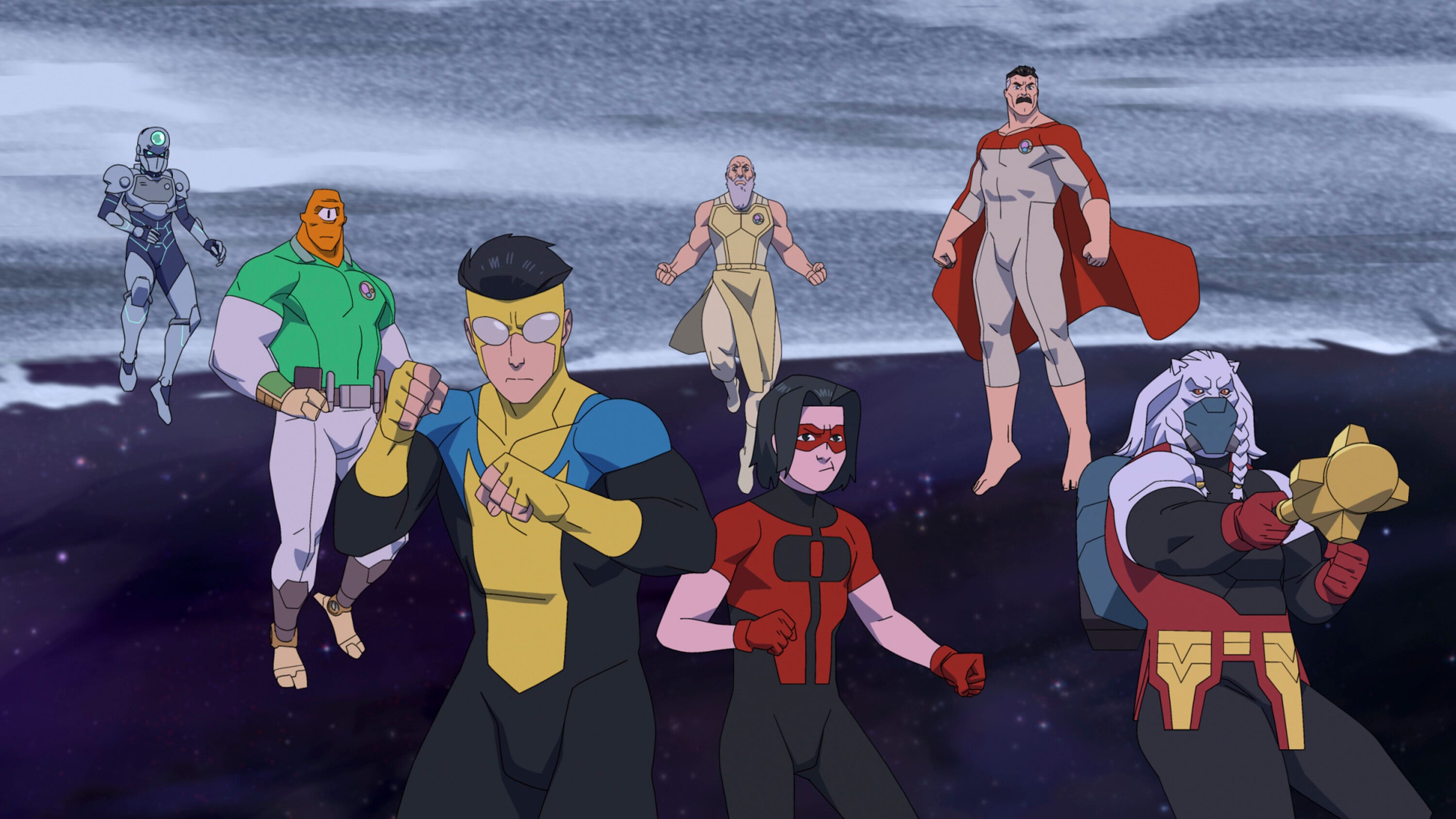
This is an episode that focuses on the story of two people: Thaddeus, the leader of the rebels and the leader of the Coalition of Planets, and then Invincible’s big bad: Thragg.
It’s the culmination of a clash of events between rebellion and empire, freedom versus control, and ideology and reality. And the stakes and weight of what happens here are huge.
Last week, the coalition homeworld of Talescria was attacked. This week, is the counterassault led by the coalition against the Viltrum Empire. Without giving away too much, this is the big display of power we’ve been waiting for all season.
Yet, when we started, Mark was terrified of becoming his father. He was losing control and killing people to make things easier. That tension drove everything in the first few episodes up until we entered war, which has been rife with Mark and friends making these hard decisions time and again.
Which leaves Episode 7 in a strange place...
Because the material understands its themes: the failure of fascism, the fragility of power, and the inevitability of an absolute empire’s collapse. But understanding something and making us feel it are two very different things. Invincible has been all about the latter. But understanding the cost of war… that’s what this episode is about.
However, embargoes are strict for this one to REAAAAALLLLYY not spoil the big things to come. So instead… I’m going to tell it to you, metaphorically speaking, with a schooly lecture about… why Fascism is bad.
Fascism is Bad and Invincible Understands how to Depict it
The war machine of fascism is so institutionalized to sell you a great lie: that strength is everything; the strong rule, and the weak, and the vulnerable, and the needy? They deserve to fail, be blamed, or even, be subjugated.
But when Adolf Hitler saw his empire crumble… he began to realize the error of his ways, that ultimately, might was not right, and that despite being so close to victory… Hitler lost. Like the loser that he always was…
He chose to end his life as a coward. The day he died. The day THAT happened, when this, hypocritical, noisy warmongering piece of shit who wouldn’t stop running his mouth, whose bloodline today, has gone so far in the shame direction as to choose to end their own bloodline intentionally–that NO DESCENDENTS of Adolph Hitler are ever to exist...
When that day comes for neo-fascists. I hope we remember.
That is what this episode of Invincible is all about.
The Viltrumites depicted here are a commentary on fascism.
They’re run by the military.
Practice Eugenics.
Are led by those deemed the strongest.
And even though Thragg is the strongest Viltrumite in the series, complaints online have been that he hasn’t been intimidating enough.
There has been no “holy shit” arrival moment like Conquest, nor any defining moment of horror, granting silent moments of shock. For someone built up as the apex predator of the Viltrum Empire, he still feels… somewhat theoretical.
Until now. Which is kind of the point.
Thragg was bred for war. The purest expression of Viltrumite ideology. He’s the Superman amongst Supermen, which is why he’s been off the playing field.
Strangely, Thragg’s voice actor, Lee Pace, was also the voice for Ronan the Accuser himself in the MCU, so I’m not fully buying into the controversy lately of him not being intimidating enough. But what I think people mix up is the idea that a Superman needs to act super. When in reality…
Supermen are rarely people who act. They’re more propaganda machines & symbols of a movement.
Bear with me, we’re talking A LOT of philosophy in this section. Skip to the next subheading if you want to skip it
The basis of the Viltrumites is obviously the Kryptonians from DC, based on creators Siegel and Shuster’s early childhood influences, which were a major basis for Superman. For those who don’t know, these inspirations are rooted in the Jewish stories of Moses: a man sent away as an infant to become a savior for his people, but also in the story of the Golem: a super-strong, virtually indestructible creature serving as defender of the oppressed.
Thus, let’s look at the popular concept of Superman. The Übermensch, based on ideas taken from the French philosopher Friedrich Nietzsche. The philosopher has been quoted in a lot of fiction over the past twenty or so years, and was most famous for popularizing the philosophy of nihilism, which, in the pop cultural sense of the way, has been abused and misinterpreted regarding its intention by an entire generation of edge lords. Mostly, in using nihilism as a means to justify their very shitty behavior:
“Nothing means anything, everything is meaningless, whatever, I’ll do what I want…”
You know… Manosphere bro type behavior.
The basic premise of the Übermensch was this idea that, because God is Dead—not in a literal sense of the word but in regards to its relevance and place in the world—Nietzsche believed so too, that we were losing humanity’s authority and guide to morality. That we essentially lost what gave humanity our values to prioritize in this world.
A culture thus devoid of purpose needs to become something more. Something beyond human. Something beyond man, in that patriarchal sense of the words used back in the day, and in this case, become an Übermensch, or superman, to rise above the constraints of the pantheons of morality now long gone, and follow our drive for individualism. And really, to start to live our lives according to our own purpose.
To find the will to live, or else fall to nihilistic tendencies. The latter of which should be stressed as the takeaway, not praise of the philosophy of nihilism.
Yet, the Übermensch also coincided with an inflection point in history. The rise of Nazi fascism a few decades later, which would, of course, appropriate it. That Reich, repurposed the Übermensch for their own political beliefs to fuel it’s own rampage in justifying genocide, fueled by the bastardized of the source along with its iconography of Nordic Mythology.
The Nazi’s would take the Übermensch idea as a propagandist calling marketing a supreme Aryan race. Their justification towards commiting horrendous war crimes.
If my writing teaches anything… It’s that everything that is a story has been told before. That all of this is more or less history.
The Superman/Übermensch was so much less about powers, or even perfection in the very deranged Eugenics sort of way… what it is, and has always been more about… is an idea. A symbol… for whatever that may be.
That humankind can do better. It’s just often been taken the wrong way.
Obviously Fascism Sucks
Historically, Fascism itself doesn’t collapse because it lacks strength—rather, it collapses because strength is often all that it has. All it values.
Honestly, you can’t build a civilization based on principles of “survival of the fittest” without eventually turning that philosophy inward. Scarcity hits. Trust erodes. Paranoia spreads.
A world built on strength alone, driven by conquest, leads to the conclusion that your neighbor will inevitably always become your enemy. Thus, power becomes something you take to hoard, not something meant to be shared.
The problem with Nazi Germany was the same as that of current neo-nazis and those of any conqueror abusing power. Survival of the fittest leads to the demise of ourselves, especially when a war is over, and you start having scarcer resources, which is, honestly, the biggest precursor to an empire’s demise. When Kings mistrust their own neighbors for the sake of maintaining power and control, and of course, conquer and subjugate by fear in attempts to maintain the great illusion of order?
It’s the bottom of the cycle.
You’ve seen it in fiction with works like Macbeth. Game of Thrones. East of Eden. The Crucible. The idea that absolute power corrupts absolutely, especially when someone tries their best to maintain it.
We take a look at the history of Ancient Rome—our western predecessors—with its many emperors that rose and fell, assassinated over and over again. Not because they were weak, mind you, but because the system itself devoured them. It was built for conquest and victory. Yet historically, when there were fewer food and resources? When a class or generation of people feel less stability? Then came more knives in the dark.
And the easiest way to topple an empire?
Was to kill the king
And that, my friends who read these reviews… is my most metaphorical and least spoilery way possible to say what this episode is really about.
Episodes of Invincible are available to stream on Prime Video. New episodes drop Wednesdays at midnight PST.